
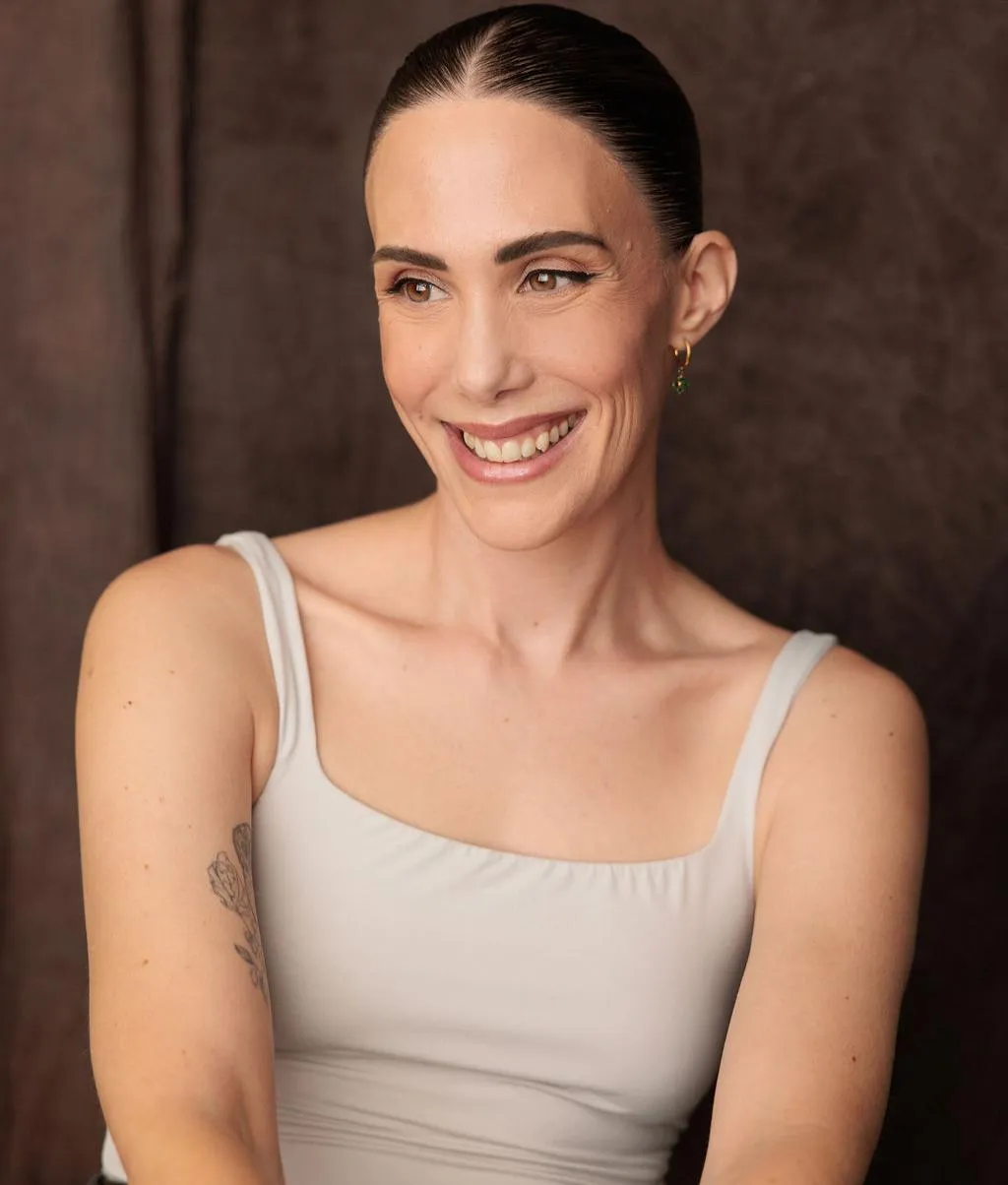
About Nat Hugill
Nervous System & Burnout Coach for High-Achieving Women
“
Working with Nat has been one of the most meaningful investments I’ve made in myself. Our mahi together created a space where I could unpick long‑held patterns, understand myself with more compassion, and build the tools I needed to stay regulated and resilient. Nat brings a rare blend of insight, presence, playfulness and genuine care. I’m profoundly grateful for the impact this journey has had on me.
- ANGE
Thrive 1:1 client

My Story
"I wore my burnout like a perfectly tailored suit; impeccably presented, professionally flawless, hiding that I was slowly unravelling underneath."
For nearly two decades, my life played out in high-stakes, high-pressure spaces. I was producing metro, major and global events, directing my own event production company, running performing arts academies and commanding stages across New Zealand as a professional MC and performer.
I was the woman who could hold it together under any amount of pressure. I had zero margin for error and the capability to match. I wore those beliefs like a badge of honour.
But my worth was entirely fused with achievement. Another project, another accolade, another proof point to convince myself I was enough. Pushing through worked - until it didn’t.
As the demands grew, my boundaries eroded so gradually I didn't even notice they were gone. I worked my basic needs - eating, sleeping, resting - around my schedule, rather than the other way around.
I told myself I was "too busy" to stop and "didn't have time" to deal with it. What I didn't see coming, was that the very things I was praised for - being reliable, available and "going above and beyond" - were the very things that would push me over the edge.
The Turning Point
Then came the career-defining project. I threw every ounce of myself into it, pulling 80-hour weeks for months, convinced this milestone would finally make me feel like I earned my seat at the table.
I finished the project, but it broke me. I didn't actually admit I'd burnt out until six months down the track, two days before my 37th birthday, when the signs of burnout had become too loud to ignore anymore. Like the bone-deep exhaustion sleep wouldn't fix, the shoulders that never fully dropped, the numbness I felt towards things that used to bring me joy and the 1am spiralling thoughts when sleep refused to come. I finally admitted to my husband that I couldn't keep going anymore, and on the day of my birthday - I was diagnosed with chronic burnout.
It took eight months of my life - my career, my income, my independence and my health. But, burnout forced me to do the one thing I had refused to do: stop, and take a very honest look at what drove me to this state in the first place.
What I came to understand during that recovery anchors my practice today; that the patterns that drive most women to burnout didn't start at work.
They started long before - in the wiring, the conditioning and the internal blueprint that said being capable, reliable and available was how women earned their place. In my case, work just gave those patterns their biggest stage yet. I needed to work with my nervous system, not against it - not to think my way out of burnout, but to feel my way through it.
Life On the Other Side
Today, my ambition hasn't changed, but the fuel has. Life feels easeful now, with a clarity and sustainable energy I thought I’d lost. I make decisions without the exhausting second-guessing and I hold firm boundaries without offering an apologetic explanation. I’ve stepped off the treadmill of needing the next accolade to validate my worth.
And one of the most profound shifts? Choosing to prioritise my own wellbeing didn't take away from the people I love - it gave them so much more. It allowed them to finally get the present, available version of me, rather than the depleted remainder left over from work.
Coming out the other side changed my entire trajectory. I retrained, pivoted my career and built this practice from scratch because I know exactly how many high-achieving women are walking this exact same tightrope. I wanted them to have the support I wish I’d had when I was in the thick of it.
Your experience is entirely your own, but if anything in my story, or on my website, has struck a chord - you're in the right place.
The Reality of Burnout for Women
Statistics paint a clear picture about the cost of chronic stress and burnout on women globally and across NZ - and what's driving it.
High responsibility and emotional demands combined with low autonomy is one of the primary structural predictors of exhaustion and burnout in women.
Source: Built for Burnout: how job design fails women (2026)
The high responsibility, emotional demands and low autonomy trifecta - and why it hits women hardest.
At work, that looks like being accountable for a project's outcomes with no say over the budget, the timeline or the team - then wearing the result when it falls short.
That lack of autonomy doesn't stay at work. At home, it's managing the invisible mental load - anticipating needs, being at the whim of the family schedule, carrying responsibilities that were never formally assigned but somehow became hers - with little say in how any of it gets redistributed.
That gap between what's expected of her and her autonomy within it is where burnout takes root.
39% of NZ women are currently operating in a high mental distress risk zone - nearly four out of ten - compared to just 27% of men
Source: TELUS Health Mental Health Index NZ
This isn't a bad week - this is running on empty as a permanent state of being.
Her energy chronically depleted, exhausted in a way that sleep doesn't fix. Functioning, performing, holding it together on the outside - but inside, knowing the way she's living is not sustainable.
The research points to three core pressures driving this risk:
1. Financial Strain: Money stress hits harder when she is the one mentally calculating every expense and stretching finite resources to keep the household safe.
2. The Invisible Load: Pressure compounds when the workday ends but the mental labor doesn't—the scheduling, domestic logistics, and emotional caretaking absorb whatever capacity is left, leaving zero time for her system to recover.
3. Isolation: Underneath both sits a persistent lack of real support. Plenty of people relying on her, but very few she feels safe enough to truly lean on.
Nearly four in ten NZ women are currently operating in this state..
Women in the high-risk category lose an average of 58 working days per year - nearly two months - of productivity
Source: TELUS Health Mental Health Index NZ
Physically at the desk every day, but mentally out the door.
Tasks that used to take fifteen minutes stretching into hours. All the self-awareness but no connection to motivation - knowing exactly what needs to happen with no capacity to make it happen.
When performance drops below her own standard, guilt kicks in. She pushes harder, overrides her needs and in doing so, further shrinks her capacity to cope and ability to recover.
Two months of lost productivity per year. No amount of pushing through will fix it, because pushing through is part of the problem.
Women under 55 are nearly twice as likely as men to feel guilty buying something for themselves - 46% compared to 27%. They're also more likely to be the one running the household budget, at 37% against 22% of men.
Source: Fawcett Society with Starling Bank, Hers and His: Opening up the household budget (2020)
Therapy - cancelled.
Gym membership - lapsed. Personal care - redacted.
She's the one running the budget, so she knows what every dollar could have gone on before she's even spent it. A squeeze means she absorbs the stress by clearing herself off it.
Practices that are beneficial for her wellbeing are often the first line items traded away because she easily justifies cutting things that feel "just for her."
The cruel irony? The practices she cuts are the exact ones her nervous system needs to cope. Chronic stress impairs rational thinking, so in the moments requiring her sharpest decisions about finances, career, and future - her brain is the least equipped to make them. Without those tools to regulate, she stays locked in a loop that feels impossible to break.
The Internal Shift
When you start making choices based on your own values and needs, rather than everyone else's demands, you signal safety to your nervous system. Every time you follow through on that, you prove to yourself that your judgement can be trusted - that's where reclaiming your clarity, capacity and self-trust begins.
We can't change these statistics overnight, and systemic change won't come fast enough - but what is within our autonomy to change is how we respond as individuals, and it starts with you.
The Nat Hugill Method
How it Works
Here's what each stage looks like - and the three areas this work moves across.
1. Understand through neuroscience
Together, we explore the patterns that have been running underneath - using guided inquiry and neuroscience to understand why your nervous system responds the way it does. Why your chest tightens before a meeting has even started, why joy feels out of reach even when nothing is technically wrong, why the drive to get it perfect won't switch off. These aren't personality flaws, they're learned patterns your brain built because, at some point, they kept you either safe, accepted, or valued - often all three.
2. Identify through somatic practice
Somatics (derived from the Greek word 'soma', meaning 'the living body') is the practice of working with your body's internal signals, using your nervous system as your guide. Instead of deciding what you think you should change - based on external pressure, fear-based patterns like comparison, or what everyone else expects - somatic practice helps you read what your nervous system is actually telling you is out of alignment. From there, it guides how you respond: through aligned decisions and practices that genuinely support you. That's how we determine what needs to shift - from the inside out, not the outside in.
3. Change through aligned action and neuroplasticity
From there, we build practical, aligned weekly experiments - small, structured actions that let you practise doing things differently without the pressure of getting it perfect. These experiments aren't homework - they're real-life, low-pressure opportunities to explore what actions and choices feel right for you in your day-to-day. That practice is what activates neuroplasticity - your brain's ability to rewire based on repeated patterns of behaviour. What you feed, grows. What you don't, slows.
When all three stages work together - that's how sustainable, aligned behaviour change happens.
Pillar 1: Boundaries
Most high-achieving women understand boundaries perfectly well in theory, but recognising when one has actually been overridden? That can be a different story. If you've ever said yes to an extra project before you've checked your capacity, possibly because you worry that hesitating or saying no might look like you can't handle it - that's an example of a boundary override.
The work here is developing the awareness to catch that pressure before it takes over - creating space to pause and notice what's actually driving the decision. Is it genuine want, or is it guilt? Is it aligned choice, or reactive pressure? When you can discern the difference, you can respond from what you actually want and need - leaving you feeling confident, clear and grounded in your decisions.
Pillar 2: Values
Values work is about uncovering what genuinely guides you - not what you've inherited or absorbed, but what actually matters to you as an individual. When your values are clear, they become the compass for your decisions, and choices start coming from alignment rather than people-pleasing, guilt or proving. You start making decisions more intentionally, feeling confident about who you are, what you stand for and what (and who) deserves to take precedence in your life. Plus, you start to trust that your choices reflect who you actually are rather than who everyone else needs you to be.
Pillar 3: Embodied Self-Trust
Embodied self-trust is what it feels like when your sense of worth comes from within. Most high-achieving women have spent years outsourcing their confidence to external validation: the performance review, the approval, the feeling of being needed. When that validation isn't there, it can feel like your sense of worth and purpose isn't seen or enough, which can often push you further into people-pleasing or perfectionist cycles of behaviour.
But, when you start to read your own signals, honour your own needs and trust your own judgement - without needing someone else to confirm you've made the right call - self-trust starts to rebuild (from the inside, out). Doubt still shows up - that's human, but your sense of self doesn't collapse when it does. Genuine self-trust allows you to make clear decisions without the second-guessing, rest without guilt, develop the capacity to handle life's hurdles, make room for life's pleasures and reconnect with the version of you underneath the roles and responsibilities.
“
I've never felt so seen and understood. She has a way of putting things into words without telling you what to think or do - she helped give a voice to my inner voice and build self-trust again. It feels unfathomable to have grown so much in such a short amount of time. This chronic apologiser has dramatically reduced apologising - even people at work have noticed!
- shannon
Thrive 1:1 client
Values & Practice
I support women from a foundation of inclusion, affirmation, and care.
My practice is LGBTQI+ friendly, neuroaffirming, and trauma-informed - which means you are welcome exactly as you are.
Every space I hold is grounded in collaboration, consent, and nervous system safety. By working with the nervous system - combining somatic practice and neuroscience - I help you rebuild the internal capacity to regulate, to trust yourself and to make choices that reflect your actual needs rather than external pressure.
You lead the pace; I guide the process.
My Experience & Credentials

My work as a coach is built on more than qualifications.
I am a founder, leader, and creative who has spent close to two decades operating across event production, education, live performance and media - building businesses, leading teams and delivering under pressure in environments where the stakes were high and the room for error was close to zero.
My career has spanned organisations including FIFA, Samsung, Amazon Studios, Warner Brothers, TVNZ, Vodafone, Tātaki Auckland Unlimited, Barfoot & Thompson, and Westpac, and has been profiled across the NZ Herald, Sunday Star-Times, NZ National Geographic, Newshub, Stuff NZ and Fashion Quarterly.
My experience doesn't sit behind the coaching - it runs through it. I've been the founder running on fumes, the leader in environments that demand everything and forgive nothing, the woman everyone counted on who forgot to count herself.
I know what that costs - not from a textbook, but from two decades of living it. That understanding is in every session, every conversation, and every tool I share with you.


HCANZA Accredited Coach (HCANZA-AC)
Health Coaches New Zealand & Australia
Certified Master Health & Wellness Coach
American Fitness Professionals & Associates (AFPA)
Aligned with NBHWC standards
Trauma-Led CPD Training for Somatic Practitioners
Soluma School, 2026
Positive Intelligence CPD for Coaches
Positive Intelligence ©, 2025
Graduate Diploma in Secondary Teaching
University of Auckland
BA Double Major - English & Classical Studies
University of Auckland
View my full education & training on Linked-In
“
I achieve just as much - if not more - without the stress and burnout I once thought was necessary for success.
- zoe
thrive 1:1 client

Nervous System & Burnout Coaching for Women in New Zealand
You’ve already taken the hardest step - pausing long enough to imagine a different way of living.
Whether you're looking for personalised one-on-one support or to be part of a cohort of women on a similar path, I'm here to help you stop the override and start reclaiming your clarity, capacity, and self-trust.
If something on this page has landed for you, I invite you to reach out. A CONNECT discovery call is a chance for us to talk about where you are, what you're navigating and whether we're the right fit for each other - and if we're not, I'll help point you in the right direction.



© 2026. All Rights Reserved.